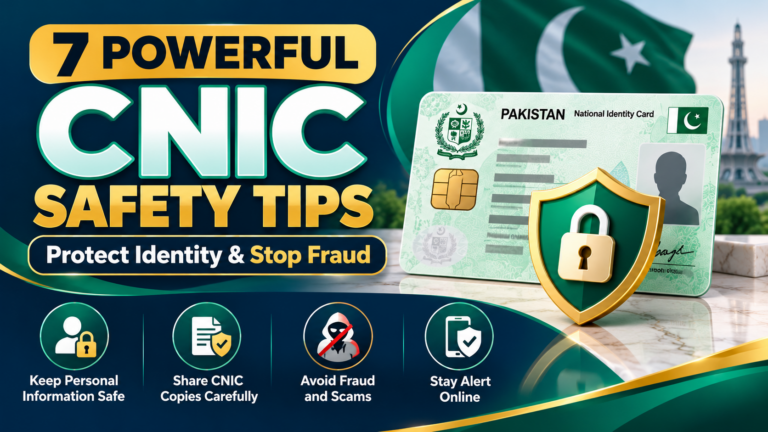
7 Powerful CNIC Privacy Tips: Protect Data & Reduce Risk
CNIC Privacy Tips are essential for protecting personal identity information in Pakistan, especially as online registration, mobile banking, digital payments, and identity verification become increasingly common in 2026. A Computerized National Identity Card (CNIC) contains sensitive personal details that can be misused when shared with unauthorized individuals or suspicious websites. Understanding effective CNIC Privacy Tips can help individuals reduce identity theft risks, recognize fraudulent requests, and keep their personal information safer in everyday digital activities.
In Pakistan, the Computerized National Identity Card is issued by the National Database and Registration Authority (NADRA). It plays an important role in identity verification, financial services, mobile connections, and various official procedures.
However, the growing use of digital identity services also creates privacy challenges. Fraudsters may attempt to collect CNIC numbers, identity card photographs, phone numbers, or verification codes through misleading messages and fraudulent websites.
This article explores seven practical CNIC privacy strategies, common security mistakes, and the importance of protecting personal identity information.
Table of Contents
- What Are CNIC Privacy Tips?
- Why CNIC Privacy Tips Matter in 2026
- Seven Powerful CNIC Privacy Tips
- CNIC Privacy Tips for Online Verification
- CNIC Privacy Tips for Mobile Banking
- CNIC Privacy Tips Comparison Table
- CNIC Privacy Tips Risk Graph
- Benefits and Hidden Risks
- Frequently Asked Questions
- Conclusion
What Are CNIC Privacy Tips?
CNIC Privacy Tips are safety practices designed to prevent unnecessary exposure of personal identity information.

These practices include limiting the sharing of identity documents, verifying official websites, avoiding suspicious links, and protecting digital copies of identification cards.
A CNIC contains information that may be valuable to criminals attempting impersonation or social engineering.
Although a CNIC number alone does not automatically provide access to someone’s bank account or digital identity, it can sometimes be combined with other information in fraudulent schemes.
Why CNIC Privacy Tips Are Important in Pakistan
CNIC information is commonly requested during legitimate registration and verification procedures.
For example, authorized organizations may require identity details when opening certain financial accounts, registering mobile services, or completing official applications.
The challenge is distinguishing genuine requests from attempts to collect personal information without authorization.
Following CNIC Privacy Tips helps individuals recognize situations where sharing information is necessary and where it may create avoidable risks.
Why CNIC Privacy Tips Matter in 2026
As more services become accessible through smartphones and websites, identity information increasingly moves through digital systems.
Online forms, messaging applications, and electronic document uploads make identity verification convenient.
However, they also create opportunities for phishing, data leaks, and accidental disclosure.
A person may unknowingly send a CNIC photograph to a fake customer service account or upload identification documents to an untrusted website.
These incidents can expose information that may later be used in impersonation attempts.
CNIC Privacy Tips for Digital Identity Protection
Digital identity protection begins with understanding how personal information is collected, stored, and shared.
Users should check whether a service genuinely needs their CNIC details before submitting them.
They should also consider whether the organization provides a secure upload process and a clear explanation of how personal information will be used.
Being cautious does not mean avoiding legitimate identity verification. It means completing verification through trusted and authorized channels.
7 Powerful CNIC Privacy Tips to Protect Personal Data
1. CNIC Privacy Tips for Avoiding Unnecessary Sharing
One of the most effective ways to protect CNIC information is to avoid sharing it without a legitimate reason.
People sometimes send identity card photographs through messaging applications for informal registrations, online purchases, or unverified job offers.
Such practices can expose sensitive information to individuals who may not have appropriate security measures.
Before sharing a CNIC copy, verify the recipient’s identity and determine whether the document is actually required.
When possible, use an organization’s official and secure document submission process.
CNIC Privacy Tips for Sharing Document Copies
If a legitimate organization requires a CNIC copy, ask whether unnecessary details can be concealed or whether the copy can be marked for a specific purpose.
Where permitted, a purpose-specific watermark may discourage casual reuse.
However, watermarks do not guarantee protection against misuse, and some official verification procedures require an unmodified document.
Always follow the receiving organization’s legitimate requirements.
2. CNIC Privacy Tips for Identifying Fake Websites
Fraudulent websites may imitate government agencies, financial institutions, or identity verification platforms.
These websites often use familiar logos, official-looking layouts, and urgent messages to encourage visitors to enter personal information.
Some claim that a CNIC will be blocked unless immediate verification is completed.
Others promise financial assistance, refunds, or registration benefits in exchange for identity details.

A safer approach is to access official services by entering their verified web addresses directly.
CNIC Privacy Tips for Checking Website Authenticity
Check the complete website address before submitting personal information.
For NADRA-related services, begin with the official NADRA website at https://www.nadra.gov.pk/.
Remember that HTTPS encryption alone does not prove a website is legitimate. Fraudulent websites may also use secure connections.
Avoid websites with suspicious spelling, unexpected payment demands, or requests for information unrelated to the stated service.
3. CNIC Privacy Tips for Protecting Mobile Phone Information
Mobile phone numbers are often connected to identity verification, banking notifications, and account recovery procedures.
Fraudsters may combine publicly available phone numbers with identity information to make impersonation attempts more convincing.
Users should therefore protect both their CNIC details and their mobile account information.
Do not share one-time passwords, banking PINs, or account verification codes with unknown callers.
Legitimate organizations generally do not need customers to disclose confidential login codes during unsolicited telephone calls.
4. CNIC Privacy Tips for Secure Online Applications
Online applications sometimes require applicants to upload identification documents.
Examples include employment applications, financial services, and certain government procedures.
Before uploading a CNIC image, investigate the organization requesting it.
A professional-looking website does not automatically mean that the organization is trustworthy.
Check its official contact details, privacy information, and whether the application process is consistent with the organization’s published instructions.
CNIC Privacy Tips for Document Storage
Store digital CNIC copies in a protected location rather than leaving them in publicly accessible folders.
Use strong device passwords and enable available security protections.
Avoid keeping sensitive identity documents in shared computers or unprotected cloud folders.
If a CNIC photograph is no longer required, consider deleting unnecessary copies from devices and accounts you control.
5. CNIC Privacy Tips for Preventing Identity Scams
Identity-related scams frequently rely on urgency and emotional pressure.
A scammer may claim that a person’s CNIC has been suspended, that a SIM will be disconnected, or that a bank account requires immediate verification.
The message may include a link or telephone number controlled by the scammer.
Instead of responding directly, contact the relevant organization through its verified official channels.
This simple habit can reduce the risk of revealing sensitive information to fraudulent operators.
6. CNIC Privacy Tips for Social Media Safety
Social media platforms can unintentionally expose personal identity information.
Some users upload photographs of newly issued CNICs, identity documents, or official forms without recognizing the privacy risks.
Even partially visible information may reveal names, dates, document numbers, or other details.
Avoid posting identity cards publicly, including in profile pictures, comments, and group discussions.
When requesting assistance online, describe the problem without displaying confidential identity information.
7. CNIC Privacy Tips for Reporting Suspicious Activity
Recognizing suspicious activity early can help limit further exposure.
If someone has shared CNIC information with a suspicious website or individual, they should preserve relevant messages and website details for reporting.
The appropriate response depends on what information was disclosed.
For example, exposure of a CNIC photograph may require different precautions from disclosure of banking credentials or an account verification code.
Contact the relevant bank, telecom operator, or identity authority when appropriate.
Cybercrime complaints should be directed through the current official reporting channels in Pakistan.
CNIC Privacy Tips for Online Verification
Online identity verification can be convenient when performed through trusted services.
However, users should distinguish between genuine verification procedures and websites that simply collect personal information.
Official platforms generally explain the purpose of identity collection and provide established contact channels.
CNIC Privacy Tips for NADRA Services
People seeking CNIC-related services should use NADRA’s official website or authorized service centers.
Avoid advertisements or unofficial agents promising guaranteed CNIC verification, immediate approval, or access to private identity records.
Never provide confidential account credentials to someone claiming to work for an identity authority without independently verifying the request.
CNIC Privacy Tips for Mobile Banking
Mobile banking services may require identity verification to comply with financial regulations and protect customer accounts.
Customers should use their bank’s official mobile application or website.
They should also enable strong authentication features, keep banking applications updated, and review transaction notifications.
If an unexpected identity verification message appears, contact the bank directly instead of following links in unsolicited messages.
CNIC Privacy Tips for Banking Fraud Prevention
CNIC information can sometimes be used in social engineering attempts, especially when criminals already possess additional personal details.
Protecting financial accounts therefore requires more than keeping an identity card number private.
Strong passwords, secure devices, and careful handling of verification codes provide additional layers of protection.
CNIC Privacy Tips Comparison Table
The following table summarizes common privacy threats and appropriate preventive actions.
| Privacy Threat | Possible Consequence | Recommended Protection |
|---|---|---|
| Sharing CNIC photographs publicly | Identity information exposure | Avoid public uploads |
| Fake NADRA websites | Personal data collection | Use verified official websites |
| Suspicious verification calls | Social engineering fraud | Independently contact the organization |
| Unprotected digital copies | Unauthorized document access | Use protected storage |
| Fake job applications | Identity document harvesting | Verify employers |
| Sharing banking OTPs | Account takeover risk | Keep verification codes private |
| Unofficial registration agents | Potential identity misuse | Use authorized service providers |
These protective measures are most effective when combined rather than used individually.
CNIC Privacy Tips Risk Graph
The following graph uses illustrative risk scores to compare different unsafe information-sharing behaviors.
Illustrative privacy risk scores — not official statistics
| Activity | Example Risk Score |
|---|---|
| Publicly posting a CNIC photograph | 9/10 |
| Uploading CNIC to an unknown website | 9/10 |
| Sharing CNIC through an unverified chat | 8/10 |
| Keeping copies in an unprotected folder | 7/10 |
| Using a verified official submission channel | 2/10 |
The scores are educational examples, not measured probabilities or official cybersecurity findings. Actual risk depends on the recipient, information involved, security controls, and surrounding circumstances.
Benefits and Hidden Risks of CNIC Privacy Tips
Following CNIC Privacy Tips can reduce unnecessary personal data exposure and make identity-related fraud more difficult.
People who verify requests before sharing documents are less likely to provide information directly to scammers.
Secure storage and careful online behavior also help protect other sensitive records.
However, privacy precautions cannot eliminate every risk.
Even legitimate organizations may experience security incidents, and some official services require identity information to be submitted.
The goal is therefore to reduce unnecessary disclosure while continuing to use legitimate services safely.
CNIC Privacy Tips and Personal Responsibility
Identity protection is a shared responsibility between individuals and organizations.
Users should handle documents carefully, while organizations should collect only necessary information and apply appropriate security measures.
Clear privacy policies, secure document processing, and responsible data retention practices are important for maintaining public trust.
Frequently Asked Questions About CNIC Privacy Tips
What Are the Best CNIC Privacy Tips?
The most useful practices include avoiding unnecessary document sharing, using official websites, protecting digital copies, and refusing suspicious requests for verification codes.
Is Sharing a CNIC Number Online Safe?
Sharing a CNIC number may be necessary for legitimate services, but it should not be provided to unknown websites or individuals without a valid reason.
Can Someone Misuse a CNIC Photograph?
A CNIC photograph may be used in impersonation or fraudulent identity collection attempts. Whether it enables a particular transaction depends on the safeguards used by the service.
How Can CNIC Privacy Tips Prevent Online Fraud?
They help people recognize suspicious requests, limit unnecessary disclosure, and use safer verification channels.
What Should I Do If My CNIC Information Is Leaked?
Stop communicating with suspicious parties, preserve evidence, secure any affected accounts, and contact relevant official organizations if misuse is suspected.
Conclusion: Why CNIC Privacy Tips Matter
CNIC Privacy Tips are an important part of protecting personal identity information in Pakistan’s growing digital environment.
From avoiding fake websites to securing identity document copies, everyday precautions can reduce unnecessary exposure and make identity-related scams easier to recognize.
The seven strategies discussed in this article provide practical guidance for safer identity verification, online applications, mobile banking, and document sharing.
Although no privacy measure guarantees complete protection, consistent security habits can significantly improve personal information management.
By following reliable CNIC Privacy Tips and using authorized services, individuals can protect sensitive identity details and reduce avoidable digital risks.